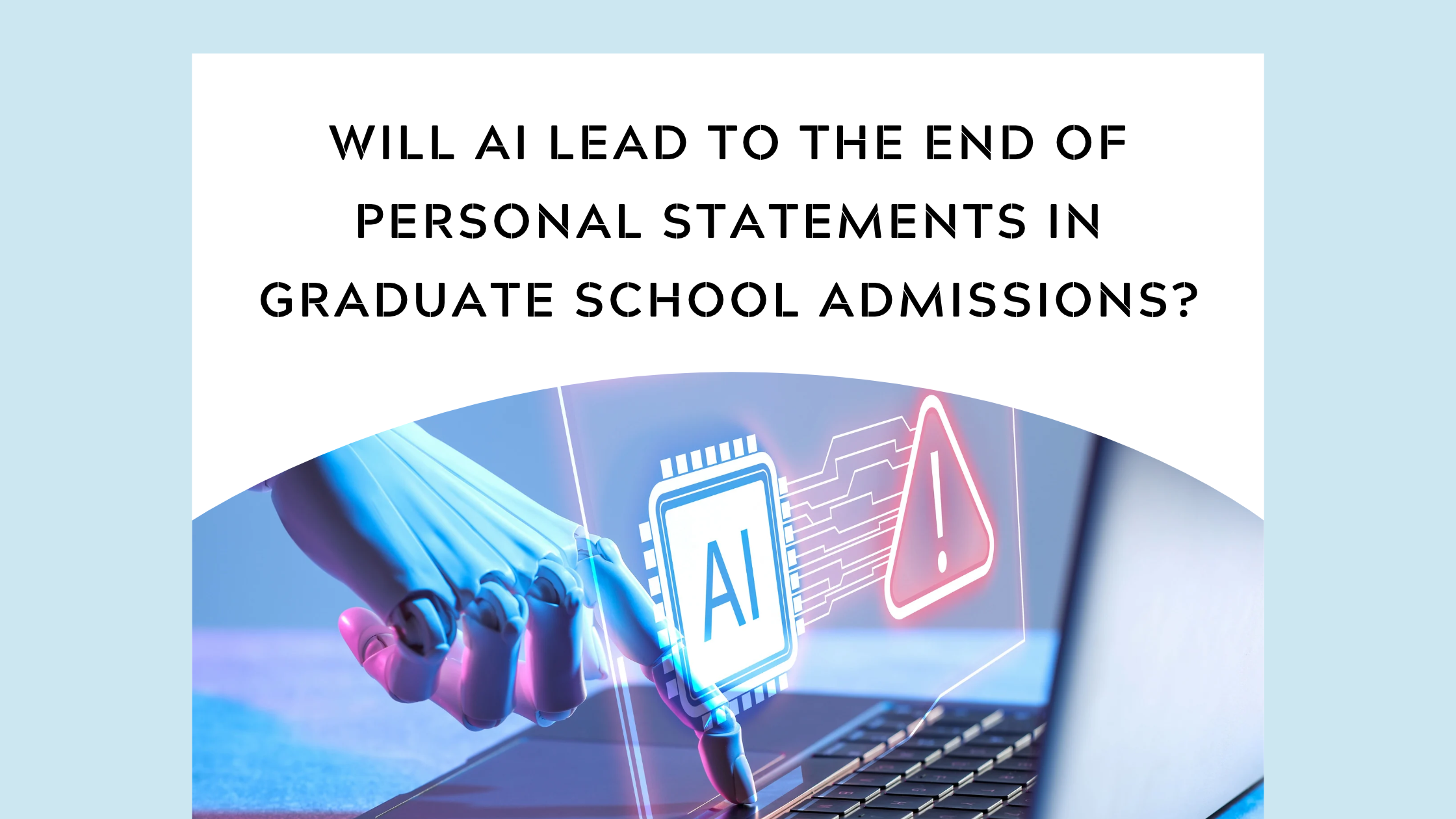
Artificial intelligence is changing higher education, and graduate school admissions are no exception.
With tools like ChatGPT making it possible to generate a personal statement in seconds, universities are facing an important question: How can admissions committees know whether an applicant's personal statement genuinely reflects their own experiences, ideas, and critical thinking?
Some universities are already experimenting with alternatives to traditional admissions essays.
For example, at a recent event presented by members of the National Deans and Directors of Social Work Admissions (NDDSWA) called Meeting Students Where They Are - Strengthening Recruitment for Graduate Social Work Education, I learned that the University of Chicago's Crown School of Social Work is experimenting with a two-minute video essay component and are assessing how it might shape their admissions process going forward.
This raises an interesting question: Could personal statements eventually disappear altogether?
As the founder of MSW Helper, I've spent the past eight years helping students prepare competitive applications for Master of Social Work (MSW) programs. Our team reviews approximately 1,000 personal statements each year, giving us a unique perspective on how applicants approach their writing, what they struggle with, and how AI is influencing the application process.
And based on what I've seen, I think eliminating personal statements because of AI could be a mistake, especially in a profession like social work.
In this article, I explore:
What I've observed about AI use after reviewing thousands of MSW personal statements.
Why personal statements remain valuable for assessing applicants
How eliminating personal statements could disadvantage certain applicants and create new accessibility barriers.
Whether interviews and other alternative assessments are effective replacements.
How AI could actually make graduate admissions more equitable.
What universities can do to adapt their admissions processes without losing sight of what matters most: identifying applicants with the potential to become excellent social workers.
Is AI Really Taking Over Personal Statements?
You might assume that with ChatGPT and other AI tools becoming so accessible, nearly every applicant would be using them to write their personal statements.
But that hasn't been my experience.
Despite reviewing approximately 1,000 personal statements annually, I've been surprised by how few appear to be heavily AI-generated.
Of course, I can't know for certain whether somebody has used AI, and my observations are limited to the applicants we work with. However, I haven't noticed a dramatic change in the quality or overall content of personal statements over the past four years.
In fact, most applicants spend months pouring over the details of their personal statement because they know just how important it is to get it right.
There are certainly statements where I strongly suspect AI has been used to generate substantial portions of the response. But these are relatively uncommon in the applications we review.
And, when I encounter an obviously AI-generated response, I often wonder whether that applicant would have struggled to write a strong personal statement even without AI.
What AI-Generated Personal Statements Often Get Wrong
One of the biggest problems I see with heavily AI-generated personal statements is that they can sound impressive without actually saying very much.
The writing might be grammatically correct, sophisticated, and full of terminology relevant to social work. But when you look beyond the surface, there isn't much depth.
For example, an applicant might write something about being committed to social justice, addressing systemic oppression, and empowering marginalized communities.
But what does that actually tell an admissions committee about the applicant?
How did they develop their understanding of social justice?
What experiences shaped their perspective?
Have they ever recognized or challenged their own biases?
How have their experiences influenced their approach to working with others?
A personal statement that simply repeats broad concepts without exploring these questions isn't particularly compelling.
Strong personal statements go deeper and demonstrate critical thinking, self-reflection, and an understanding of your own experiences.
That's something AI can't genuinely do on your behalf.
Why Personal Statements Are Still So Important
One of my biggest concerns about eliminating personal statements is what admissions committees might lose in the process.
A transcript tells you how someone performed academically.
A resume tells you what kind of experiences they've had.
But neither necessarily tells you what they've learned from those experiences, how they've developed their values, or why they might become an excellent social worker.
That's where personal statements become incredibly valuable.
Personal Statements Give Applicants a Chance to Explain Their Experiences
One of my favourite examples involves people who are making career changes.
Let's say someone has spent the past ten years working in banking.
On paper, that might not seem particularly relevant to social work. If an admissions committee were simply comparing professional experience, another applicant with several years of direct social service experience might initially appear more qualified.
But what happens when we dig a little deeper?
Maybe that financial advisor worked extensively with low-income families and developed an understanding of the systemic barriers they face. Maybe they witnessed how financial instability affects people's mental health, family relationships, or access to opportunities, and those experiences ultimately motivated them to pursue a career addressing these challenges at a deeper level.
On the resume, a banking role might seem irrelevant, but the personal statement tells a totally different story.
I've also worked with applicants from unconventional backgrounds, including someone who had experience as a reporter.
For example, at first glance journalism and social work might seem like completely different professions.
But through their personal statement, this applicant was able to explain how their experiences reporting on social issues shaped their understanding of systemic challenges and motivated their decision to pursue social work.
We can even look at someone who works in a coffee shop.
Maybe they've spent years interacting with customers experiencing homelessness. Perhaps they've developed relationships with regular customers, learned about the challenges they face, and started questioning why adequate support isn't available.
These experiences might not stand out on a resume, but they could provide valuable insights into that person's potential as a future social worker.
And that's exactly why personal statements are so important when assessing an applicant.
It's not just about what you've done. It's about what you've learned, how you've grown, and how those experiences have shaped your understanding of the world.
Without personal statements, I worry that universities could overlook some truly exceptional applicants.
Could Interviews Replace Personal Statements?
I actually think interviews can be an excellent way to assess prospective social work students.
When I meet with applicants one-on-one, I'm often able to recognize strengths that weren't immediately apparent from their written materials.
I'll ask someone why they're interested in social work, and they'll give me a relatively generic answer.
But then I'll ask a follow-up question.
Maybe I'll ask what specifically drew them to the profession, how their experiences have influenced their understanding of social issues, or whether they've ever encountered a situation that challenged their assumptions.
Suddenly, the conversation becomes much more interesting.
With a little encouragement, applicants often start sharing insightful reflections and experiences that demonstrate their potential to become excellent social workers.
I can see how admissions committees could benefit from having these conversations.
An interview also gives applicants an opportunity to discuss experiences they couldn't fit into their personal statement.
Word counts are a major challenge for many students. When you only have 500 or 1,000 words, you have to be selective about which experiences to discuss.
A conversational interview could give admissions committees an opportunity to explore other aspects of an applicant's background.
But there are some significant limitations:
Not Everyone Performs Well in an Interview
Some people are excellent at communicating verbally and thinking on the spot.
Others need more time to process questions, organize their thoughts, and articulate their ideas.
That doesn't necessarily mean they're less capable of becoming excellent social workers.
For applicants with certain disabilities, language barriers, or anxiety around interviews, responding to unfamiliar questions under time pressure could be particularly challenging.
Personal statements give applicants an opportunity to think carefully about what they want to communicate.
Many of the students we work with spend months preparing their statements. They go through multiple drafts, seek feedback, reflect on their experiences, and work hard to put their best foot forward.
For many, applying to an MSW program is an incredibly meaningful step in their lives.
I would hate to see that opportunity for thoughtful preparation disappear in favour of an assessment where somebody has only a minute or two to formulate their response.
Prerecorded Interviews Aren't the Same as Conversations
I'm particularly skeptical about replacing personal statements with prerecorded video interviews.
In some video-based admissions assessments, applicants receive a question and have a limited amount of time to prepare and record their response.
There's no interviewer on the other end asking follow-up questions or encouraging the applicant to expand on something interesting.
And that removes what I believe is one of the most valuable parts of an interview: the human connection.
When I'm speaking with an applicant, I'm not just evaluating their initial response or staying at the surface level.
I'm asking questions that encourage them to think more deeply.
Sometimes I'll recognize a strength they haven't identified themselves, and we'll explore it together.
That's often where the most meaningful insights emerge.
If universities are going to introduce interviews, I think they should consider how to make them genuinely conversational and strengths-based rather than simply another timed assessment.
Could AI Actually Make Graduate Admissions More Equitable?
Here's something I think is missing from many conversations about AI and admissions.
You don't necessarily have to be an excellent writer to become an excellent social worker.
In fact, some of the people we most want to encourage to enter the social work profession may be the same people who have faced significant barriers in academic settings.
Think about applicants who are returning to school after many years, individuals whose first language isn't English, or people who have extensive lived experience but struggle with academic writing.
These applicants may have valuable perspectives, strong interpersonal skills, and a deep understanding of the communities they hope to serve.
But they might struggle to communicate those strengths in a traditional personal statement.
That's something we see regularly at MSW Helper and that’s a huge part of the role we have.
Our role isn't simply to correct grammar or make someone's writing sound more sophisticated.
A huge part of what we do is helping applicants recognize the value of their own experiences.
We ask questions, help them identify their strengths, and encourage them to think critically about the connections between their backgrounds and the profession of social work.
Ultimately, we're trying to help admissions committees see the same potential that we recognize when we're speaking with applicants face-to-face.
The Difference Between Using AI to Think and Using AI to Replace Your Thinking
Let's imagine someone who has spent ten years working in another profession and is now applying to an MSW program.
They know they want to become a social worker, but they're struggling to explain how their previous experience connects to the field.
They could use an AI to ask questions such as:
What transferable skills might someone working in financial services bring to social work?
What social issues might someone working in this industry encounter?
What questions should I reflect on to better understand why I want to become a social worker?
Those questions could help the applicant recognize connections they hadn't previously considered.
They could then use those insights to reflect on their own experiences and develop an authentic response.
That's very different from asking ChatGPT to write an entire personal statement for them.
In one situation, AI is being used to support the applicant's thinking.
In the other, it's being used to replace it.
And I think that's an incredibly important distinction.
Of course, applicants still need to follow the AI policies established by the universities they're applying to. Some institutions permit certain forms of AI assistance, while others have much stricter requirements.
But from a broader educational perspective, I think we need to consider whether AI could help make academic opportunities more accessible rather than assuming its use is inherently harmful.
The Real Challenge: How Can Universities Assess Authenticity?
I don't want to dismiss the legitimate concerns universities have about AI.
There's a real challenge here.
If an applicant uses AI to generate compelling reflections, describe experiences they haven't had, or manufacture a sophisticated understanding of social issues, how can an admissions committee determine whether those ideas genuinely belong to the applicant?
This isn't a problem unique to graduate admissions.
Professors across higher education are grappling with similar questions when evaluating essays, assignments, and other coursework.
And detecting AI-generated content isn't straightforward.
Applicants may be concerned about having their authentic writing incorrectly identified as AI-generated, while universities may struggle to distinguish between legitimate assistance and misrepresentation.
In fact, I've noticed that AI is contributing to anxiety among some applicants who worry their writing could be mistaken for AI-generated content.
I sometimes wonder whether that concern is one reason I'm seeing fewer heavily AI-generated statements than I initially expected.
Ultimately, I don't think universities can solve this challenge simply by trying to determine whether AI was used.
Instead, we need to think about what admissions committees are actually trying to assess.
Are they looking for excellent writing?
Or are they looking for applicants who demonstrate critical thinking, self-awareness, relevant values, and the potential to contribute to the field?
If it's the latter, I think there's an opportunity to rethink how we assess those qualities without eliminating personal statements altogether.
Universities Should Consider Improving Their Personal Statement Prompts
One area where I think universities have an opportunity to improve admissions is in how they design their personal statement prompts.
Something I frequently notice is that applicants struggle not because they lack meaningful experiences, but because they don't understand what the question is asking them to demonstrate.
For example, a university might ask:
"Describe your experience working with diverse populations and how it has prepared you for social work practice."
That seems like a reasonable question.
But many applicants respond by listing the populations they've worked with and explaining that they treated everyone with respect. They might talk about the importance of diversity, inclusion, and cultural sensitivity. But their response often doesn't demonstrate much critical reflection.
What if universities asked something more specific?
An Example of a More Reflective Personal Statement Prompt
Instead of simply asking applicants to describe their experience working with diverse populations, I would ask:
"Tell us about a time you worked with someone whose background or experiences differed from your own. How did this experience challenge you? What did you learn about yourself, your assumptions, and your own positionality? How will this experience shape your approach as a social worker?"
I think this would encourage a much more meaningful response.
One thing I've noticed when supporting applicants is that many are scared to admit they've made mistakes, held assumptions, or contributed to bias.
They think admissions committees expect them to present themselves as someone who has always handled every situation perfectly.
But that's not necessarily what makes someone a strong candidate for social work.
As social workers, we need to recognize that we're all influenced by the systems we operate within.
We all have biases, assumptions, and opportunities for growth.
Being able to recognize those things is an important part of developing as a professional.
So rather than simply asking whether someone has worked with diverse populations, I think universities should ask questions that encourage applicants to examine what those experiences taught them.
And I think schools should provide clearer guidance about what they're actually looking for.
A more specific, reflective prompt won't make it impossible for someone to use AI inappropriately. But it could encourage applicants to go beyond the generic responses that AI tools often produce.
What Would the Ideal MSW Admissions Process Look Like?
If I were designing an MSW admissions process, I wouldn't eliminate personal statements.
I think personal statements are a valuable starting point that gives applicants an opportunity to reflect on their experiences, explain their motivations, and add important context they want admissions committees to understand.
Then, if resources allowed, I would consider adding a conversational interview component.
I wouldn't necessarily make it a lengthy interview with dozens of questions.
In fact, I think two well-designed questions, combined with thoughtful follow-up questions, could reveal quite a lot about an applicant.
Question 1: Why Do You Want to Become a Social Worker?
This might seem like an obvious question, but I would want to explore it beyond the surface.
For example, someone might explain that they want to become a social worker because they're interested in becoming a therapist.
That's a perfectly reasonable career goal.
But I'd want to understand why they've chosen social work specifically.
What is it about the profession's values, theoretical perspectives, and approach to understanding people within their social environments that resonates with them?
How do they understand the relationship between individual challenges and broader systemic issues?
Why are they choosing social work as a path to becoming a therapist instead of another path like psychology?
I think those conversations could provide valuable insight into an applicant's alignment with the profession.
Question 2: Tell Me About a Time You Were Challenged
My second question would explore someone's ability to navigate conflict, reflect critically, or learn from a difficult experience.
I might ask them to describe a time when they encountered an ethical dilemma, had to reconsider an assumption, or experienced conflict with someone whose perspective differed from their own.
But rather than simply accepting their first response, I'd ask follow-up questions.
What made the situation difficult?
What would they do differently now?
How did that experience shape their understanding of themselves or others?
In my experience, applicants sometimes need a little encouragement to recognize the deeper meaning behind their experiences.
And I think creating space for that reflection would be much more valuable than putting someone on the spot with a prerecorded question and a countdown timer.
Of course, this approach would come with practical challenges. Universities would need to consider staffing, consistency between interviewers, accessibility, and how to ensure that every applicant receives a fair assessment.
But if the goal is to create a holistic, strengths-based admissions process, I think this would be a direction worth exploring.
How Should Applicants Prepare if Personal Statements Disappear?
If universities eventually move toward interviews or other alternative assessments, my advice to applicants would actually remain pretty similar.
Whether you're writing a personal statement or preparing for an interview, you still need to understand your experiences and how they relate to social work.
I would encourage applicants to reflect on questions such as:
Why do you want to become a social worker?
What experiences have influenced your decision to pursue the profession?
What have those experiences taught you about yourself and the communities you hope to serve?
How do your values align with the profession of social work?
What social issues are you passionate about, and how do you understand their underlying causes?
Can you identify a time when you navigated conflict, encountered an ethical challenge, or reconsidered an assumption?
What strengths would you bring to the profession, and where do you still have opportunities for growth?
These are the same kinds of questions we encourage applicants to explore when preparing their personal statements.
And they're valuable regardless of the format universities ultimately choose.
Will AI Eventually Make Personal Statements Obsolete?
I think AI could fundamentally change higher education at all levels.
It's already changing how students research, study, brainstorm, and write.
And over the next five to ten years, I imagine we'll see significant changes in how universities assess learning and evaluate prospective students.
Sometimes I think about AI in a similar way to the introduction of calculators.
Calculators didn't eliminate the need to understand mathematics. Instead, they changed the kinds of problems students could tackle and how certain mathematical skills were assessed.
I wonder whether AI could eventually have a similar impact on writing.
If technology can help students organize their ideas and communicate more clearly, perhaps we can place greater emphasis on the quality of their thinking.
Of course, AI introduces different challenges because it can generate ideas and reflections, not just assist with mechanical tasks. That means universities still need to think carefully about academic integrity and authenticity.
But I don't think the solution is necessarily to take a stark stance against AI or eliminate traditional assessments as quickly as possible.
I worry that some institutions may be reacting hastily to a technology they're still trying to understand.
Based on what I'm seeing through MSW Helper, I don't think there's enough reason to conclude that personal statements have lost their value.
Instead, I think universities should consider how to adapt their admissions processes to account for AI while preserving opportunities for applicants to demonstrate their potential.
Final Thoughts: The Best Social Workers Aren't Always the Best Writers
If there's one thing I've learned from eight years of helping people apply to MSW programs, it's that some of the most promising future social workers aren't necessarily the strongest academic writers.
In fact, some of the applicants who may struggle most with writing are the same applicants we want to actively encourage to join the social work field.
Some may come from diverse backgrounds, speak English as a second language, or may have experienced significant barriers in education.
Others may be career changers with unconventional backgrounds that don’t immediately stand out on a resume but can add a valuable perspective to the social work profession.
At MSW Helper, a big part of our work is helping these applicants recognize their own strengths and potential.
We help them reflect on their experiences, develop their ideas, and communicate what makes them strong candidates for social work.
Ultimately, our goal is to help admissions committees see the same person we see when we're speaking with applicants face-to-face.
I think AI could eventually play a role in helping applicants do something similar, provided it's used thoughtfully and within the policies established by their chosen programs.
And that's why I think universities need to be cautious about eliminating personal statements altogether.
The purpose of a personal statement isn't to identify the strongest writer. It's to help identify people who have the potential to become excellent social workers.
As AI continues to evolve, I hope universities keep that distinction at the centre of their decisions.
Because if we focus too much on how an applicant communicates their potential, we risk overlooking the potential itself.