8 Affordable Therapy Trainings for Social Workers, Students, and Aspiring Therapists

Affordable therapy training can be hard to find, especially if you’re a student, new graduate, or helping professional trying to build practical skills on a budget.
That’s why PESI Canada has partnered with MSW Helper to offer 8 low-cost therapy trainings at exclusive MSW Helper pricing. These trainings cover in-demand topics like EMDR, trauma-informed CBT, DBT, somatic therapy, ACT, complex trauma, suicide assessment, and Motivational Interviewing — with each training available for under $200.
Through this partnership, you can access therapy trainings in:
Interested in all of these trainings? Get all of these trainings for a bundled rate of $799!
Affiliate earnings disclosure: MSW Helper may earn a commission if you register for these PESI trainings through our link. We only share trainings we believe may be relevant to our community, but PESI trainings are provided by PESI. Please review the training details, eligibility, continuing education information, refund policies, and any professional requirements directly through PESI before registering.
Are PESI trainings worth it for social work students?
They can be, especially if you want to explore practice areas like trauma, anxiety, grief, ADHD, DBT, or mental health before entering the field. They will not guarantee admission, but they can help you become a more informed and reflective applicant.
Can I take therapy trainings before becoming a therapist?
Yes. Therapy trainings can be a helpful way to start learning about therapeutic approaches, clinical language, and common client concerns before becoming a therapist. However, trainings alone do not make you a therapist. You will still need the appropriate education, supervision, practicum experience, and regulatory pathway for your profession and location.
If you are thinking about becoming a therapist, check out our workshop recording: Becoming a Therapist with a Social Work Degree
Do PESI trainings count for continuing education credits?
Many PESI trainings offer continuing education credits, but eligibility depends on the specific training, your profession, your location, and your regulatory body. Always review the CE information on the PESI training page before registering.
Which PESI therapy training should I start with?
Start with the training that feels most relevant to your goals. If you are unsure, choose a topic that shows up across many settings, such as trauma, anxiety, emotional regulation, CBT skills.
Are these therapy trainings only for social workers?
No. These trainings may also be relevant for students, new graduates, aspiring therapists, counsellors, psychotherapists, and other helping professionals. Always check the training details to make sure it fits your background and goals.
Can I put therapy trainings on my resume or MSW application?
Yes, you can include relevant professional development on your resume or MSW application, especially if it connects to your goals or experience. Just be careful not to overstate what the training qualifies you to do.
Do these therapy trainings make me certified?
Not necessarily. Some trainings may include a certificate of completion or specific certification language, but this depends on the individual training. Always review the PESI training page so you understand what credential, certificate, or documentation is provided.
How to choose the right therapy training:
If you are interested in trauma → EMDR, Trauma-Informed CBT, Somatic Therapy, Complex Trauma
If you want structured skills → DBT, ACT, CBT
If you want crisis skills → Suicidal and High-Risk Clients
If you are interested in addictions/community work → Motivational Interviewing
If you are unsure → start with the issue or population you are most likely to encounter
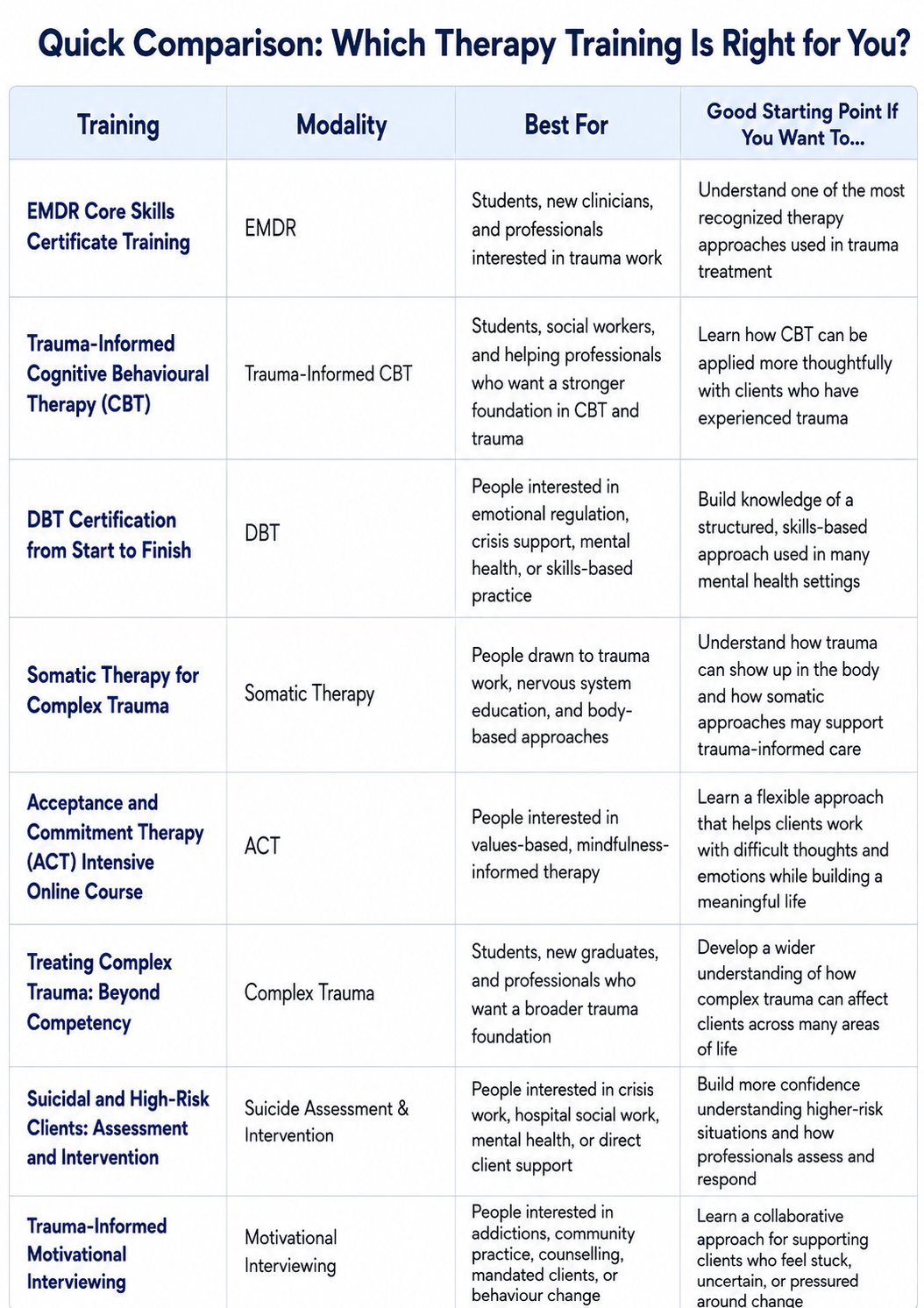
EMDR, Somatic Therapy, and Complex Trauma are strong options for readers interested in trauma work.
CBT, DBT, and ACT are helpful for those wanting to learn structured therapeutic modalities.
Suicide Assessment and Intervention may be a better fit for readers interested in crisis work.
Motivational Interviewing is especially relevant for addictions, community practice, and behaviour change work.
Can I bundle all 8 therapy trainings?
Yes. PESI Canada has created a bundled option for MSW Helper readers who want access to all 8 trainings at a lower combined price. This may be the best value if you know you are interested in several topics.
You can invest in all 8 of these trainings for a bundled rate of $799 and save hundreds! Invest once and get all the trainings you need to start building your skills in therapy and counselling.
EMDR Core Skills Certificate Training
If you are drawn to trauma work, EMDR is a modality you will likely hear about often.
EMDR is commonly used to help clients process traumatic memories and reduce the distress connected to those experiences. You do not need to be an EMDR expert to know that trauma shows up across many areas of social work and mental health practice — but learning the basics can help you better understand what trauma-focused therapy can look like.
This fully online training walks through the EMDR process from beginning to end, with 36 hours of on-demand instruction you can complete at your own pace.
You will also get access to monthly Q&A sessions with an EMDR trainer, which can be a useful way to deepen your understanding as you move through the material.
Trauma Informed Cognitive Behavioural Therapy (CBT)
A lot of students and new clinicians hear about CBT early on, but do not always understand how it connects to trauma work.
This training looks at CBT through a trauma-informed lens, helping you understand how trauma can shape a person’s thoughts, emotions, behaviours, coping patterns, and sense of safety.
If you are interested in trauma work, counselling, mental health, or direct practice, this course can help you build a stronger foundation in one of the most commonly used therapy approaches.
It is a good fit if you want to understand CBT beyond the basics and learn how it can be applied more thoughtfully with clients who have experienced trauma.
DBT Certification from Start to Finish
DBT is a skills-based therapy approach that is often used with clients who experience intense emotions, relationship challenges, self-destructive behaviours, or difficulty coping with distress.
If you are interested in mental health, crisis work, counselling, trauma, or emotional regulation, DBT is a modality worth understanding. Even if you do not plan to become a DBT therapist, the core skills — mindfulness, distress tolerance, emotion regulation, and interpersonal effectiveness — show up in many areas of practice.
This training walks through DBT in a practical way, helping you understand how the approach works, when it may be used, and how DBT skills can support clients in building safer and more effective coping strategies.
It may be a good fit if you want to build confidence with structured, skills-based interventions and learn more about a modality commonly used in therapy and mental health settings.
Somatic Therapy for Complex Trauma
Trauma does not only show up in thoughts or memories. For many clients, trauma can also show up through the body — in the nervous system, in patterns of tension or shutdown, in hypervigilance, or in difficulty feeling safe and present.
This training is a strong fit if you are interested in understanding trauma from a body-based perspective. It introduces somatic approaches that may support trauma-informed care, including movement, breathing, visualization, nervous system education, and other body-based techniques.
If you are drawn to trauma work, this can be a helpful way to learn why somatic therapy has become such an important part of the conversation around complex trauma.
The training includes demonstrations, lectures, handouts, and worksheets so you can see how these concepts may be applied in practice.
Acceptance and Commitment Therapy (ACT) Intensive Online Course
ACT is a therapy approach that combines mindfulness, values-based work, acceptance, and behaviour change strategies. It is often used with clients experiencing anxiety, depression, trauma, stress, addiction, and other mental health concerns.
If you are interested in counselling, therapy, or mental health practice, ACT can be a helpful modality to understand because it focuses not only on reducing symptoms, but also on helping clients build a life that feels meaningful and aligned with their values.
This online course introduces the core concepts of ACT and shows how the approach can be applied in clinical practice. You will also have the opportunity to watch in-session demonstrations, including demonstrations featuring ACT co-founder Steven C. Hayes and other experienced ACT clinicians.
This may be a good fit if you want to learn a more values-based, mindfulness-informed approach to supporting clients through difficult thoughts, emotions, and life experiences.
Treating Complex Trauma: Beyond Competency
Complex trauma can affect many areas of a person’s life, including emotional regulation, relationships, attachment, identity, coping, dissociation, substance use, and the nervous system.
This training is designed for people who want a deeper understanding of trauma beyond the basics. It explores topics such as Adverse Childhood Experiences (ACEs), trauma diagnoses, attachment, Polyvagal Theory, dual awareness, dissociation, addiction, and the psychological and physical impacts of trauma.
You will also learn how different trauma-informed approaches may be used in practice, including CBT, DBT, Sensorimotor Psychotherapy, Somatic Experiencing, Gestalt Therapy, and other modalities.
This may be a good fit if you are interested in trauma work and want a broader understanding of how complex trauma is understood and treated across different clinical approaches.
Suicidal and High-Risk Clients: Assessment and Intervention
Working with suicidal or high-risk clients can feel intimidating, especially for students, new graduates, or professionals who want more structure around crisis assessment and intervention.
This training focuses on how to identify and respond to higher-risk situations, including suicidal thoughts, homicidal thoughts, aggression, substance use concerns, trauma, and possible medical or mental health factors that may increase risk.
If you are interested in mental health, crisis work, hospital social work, community practice, or direct client support, this training can help you better understand what risk assessment and intervention can look like in practice.
It does not replace supervision, workplace protocols, or crisis-specific training required by your role, but it may be a helpful way to build more confidence with a challenging and important area of practice.
Trauma Informed Motivational Interviewing
Motivational Interviewing is a practical approach for supporting clients who feel uncertain, stuck, pressured, or ambivalent about change.
This training looks at how MI can be used in a trauma-informed way, especially with clients navigating concerns such as substance use, anxiety, depression, PTSD, crisis, or mandated involvement.
If you are interested in social work, counselling, addictions, mental health, or community practice, MI is a helpful modality to understand because it focuses on collaboration rather than pressure. It can help you learn how to have more effective conversations with clients while still respecting their autonomy, readiness, and lived experience.
This training may be a good fit if you want to build stronger communication skills, better understand ambivalence, and learn how trauma-informed conversations can support meaningful change.
Final Thoughts
You do not need to take every training to become for clinical practice. But if you are trying to build your knowledge, explore therapy modalities, or feel more prepared for future clinical work, these trainings can be a practical and affordable place to start.
Start with the topic that feels most relevant to your goals, or consider the training bundle if you know you want access to several areas of training.
MSW Helper may receive compensation when you register for certain PESI trainings through links shared on our website, emails, social media, or other materials. This may include a commission for paid training purchases.
We only share trainings and professional development opportunities that we believe may be relevant to social work students, social workers, therapists, helping professionals, or members of our community. However, PESI trainings are provided by PESI, not MSW Helper. Please review the training details, eligibility, continuing education information, refund policies, and any professional requirements directly through PESI before registering.