How to Write Role Description Bullet Points for Your Social Work Resume (with Before and After Examples)
Writing job description bullet points for your social work resume can feel surprisingly difficult. This is especially true if you’re applying to an MSW program and don’t have much traditional social work experience yet.
Many applicants either undersell their experience or try too hard to make every role sound clinical, and neither approach works. Instead of trying to make every job sound like social work, your goal is to help the reader understand why your experience is relevant. This principle applies whether you’re applying to an MSW program, trying to land a field placement, or job-hunting.
Admissions reviewers and hiring managers aren’t just looking at where you worked or volunteered and what you did. They are also looking for evidence of the responsibilities you held, the populations or communities you’ve worked with, the skills you developed, and the ways your experience has prepared you for social work education, field placement, or practice.
Note: This article focuses specifically on writing strong role description bullet points. For a broader overview of what to include in your social work resume or CV, how to organize your sections, and how to format your document, start with our guide on How to Write Your Social Work Resume.
The Biggest Mistake: Listing Tasks Without Showing Relevance
A resume bullet can be accurate and still not be very persuasive. For example:

Weaker Bullet: Scheduled client appointments and responded to phone inquiries. Stronger Bullet: Coordinated client appointments, responded to service-related questions, and routed urgent concerns to appropriate staff.
Notice how the first example is clear, but it mostly just describes the task. The stronger bullet shows the skill behind the task and demonstrates greater relevance to social work; it demonstrates communication, judgment, coordination, and comfort interacting with people seeking support.
Here are a couple more examples:
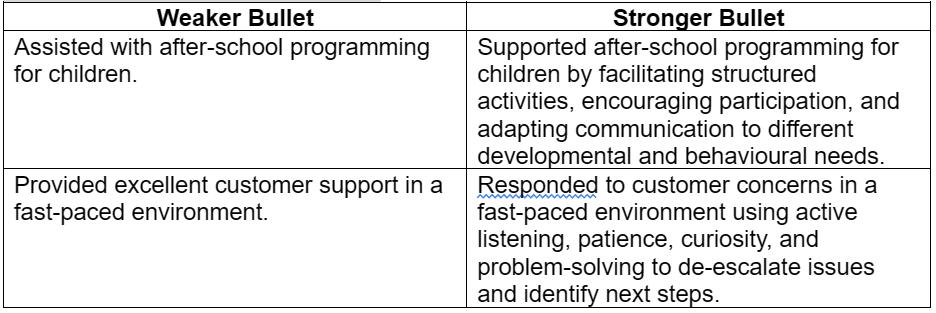
Weaker bullets: Assisted with after-school programming for children. Provided excellent customer support in a fast-paced environment. Stronger bullets: Supported after-school programming for children by facilitating structured activities, encouraging participation, and adapting communication to different developmental and behavioural needs. Responded to customer concerns in a fast-paced environment using active listening, patience, curiosity, and problem-solving to de-escalate issues and identify next steps.
Don’t make the reader work too hard to understand why the experience matters. The goal isn’t to inflate the experience, but to make the transferable skills and context easier to see.
If you’re struggling to name relevant skills in your experience, our list of 119 Social Work Skills You Can Add to Your Resume can help you brainstorm. Just remember, the strongest resumes don’t simply list skills. They show those skills in action using specific behavioural examples of what they did.
What if I don’t have social work-relevant experience?
This tip is especially important for MSW applicants who worry their experience isn’t relevant to social work. The good news is you likely do have social work-relevant experience; you just don’t realize it yet.
A front desk role might involve being the first person someone speaks to when they are confused, frustrated, or trying to access support. A tutoring job might involve noticing when a student is overwhelmed or being impacted by contextual factors and adjusting your approach instead of pushing ahead. A research position might involve learning how social issues are studied, measured, or misunderstood. A customer service role might involve staying calm with people who are upset while still working within policies you didn’t create.
To help find the relevance, ask yourself questions like:
Did I interact with people who were stressed, overwhelmed, frustrated, or trying to access support?
Did I have to adjust my communication based on someone’s age, needs, emotions, or circumstances?
Did I help people understand options, resources, processes, or next steps?
Did I work within policies or systems that affected people’s access to support?
Did I handle confidential or sensitive information?
Did I observe anything about inequality, barriers to services or well-being, family stress, disability, mental health, poverty, education, housing, healthcare, or community needs?
Did I have to stay calm, professional, and boundaried in difficult interactions?
Those are often the parts of the role worth highlighting.
You may also want to read our guide on How to Get Accepted to MSW Programs Even if You Have No Social Work Experience.
A Simple Formula for Strong Social Work Resume Bullets
A useful formula to keep in mind as you’re writing your resume is:
Action verb + population or setting + what you did + how or why + result or relevance
Not every bullet needs to follow this formula perfectly, but it is a useful tool for moving beyond basic task descriptions.
For example:
Facilitated weekly reading sessions with children in foster care, building consistency and trust using trauma-informed relationship-building strategies, such as predictable routines, choice, encouragement, and calm responses to frustration.
Responded to phone inquiries from clients and community members, gathered relevant information, triaged requests, and directed individuals to appropriate staff or services while maintaining confidentiality.
Coordinated appointments, managed confidential records, and communicated with clients and staff to support timely access to services.
Start with a Quick Overview Bullet When Helpful
You can also use the first bullet under a role to give a quick overview of the position.
If you just met someone and they asked you what you did in that role, you probably would not start with a small task. Instead, you would give them a quick overview of the role.
For example:
Supported after-school programming for youth ages 10–14 in a community-based program focused on recreation, homework support, and social connection.
That kind of first bullet helps orient the reader before you move into more specific responsibilities, skills, or accomplishments.
This is especially useful when your role title is vague, such as Program Assistant, Support Worker, Volunteer, Research Assistant, Administrative Assistant, or Community Outreach Intern. In these cases, the first bullet can quickly clarify the setting, population, and purpose of the role.
Quantify Scope, Not Just Outcomes
Many resume guides tell applicants to quantify their accomplishments. This is good advice, but social work applicants often get stuck because they don’t always have business-style metrics to showcase. You may not know whether you “increased engagement by 25%” or “improved outcomes by 40%,” and that’s okay. You can quantify scope instead.
For example, you can include things like:
Number of clients, students, residents, or families served
Age range of the population
Caseload size
Number of group sessions facilitated
Frequency of service
Number of volunteers trained
Number of referrals completed
Number of program participants
Number of hours completed
Size of team
Numbers help readers understand the size and scope of your experience.
For example:
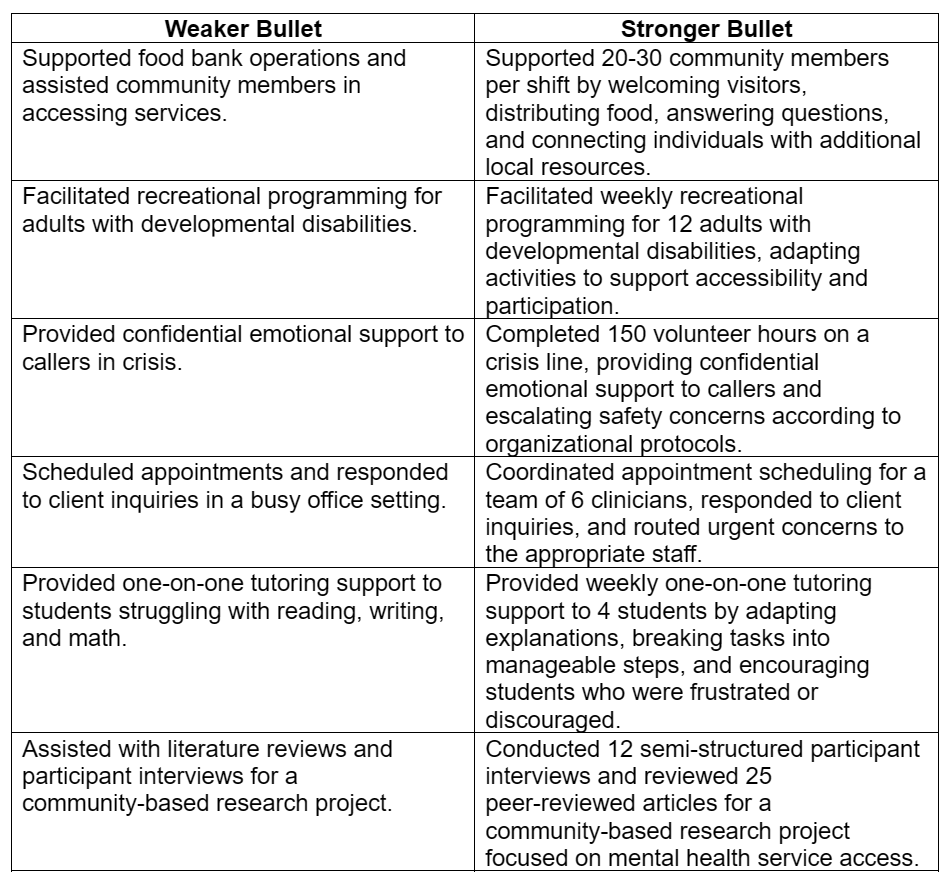
6 examples of weaker vs. stronger bullet points. Email info@mswhelper.com for text version.
What if I don’t know my numbers?
If you don’t know exact numbers, you may be able to use a truthful estimate, such as “approximately,” “up to,” “an average of,” or similar. For example, “supported approximately 15-20 clients per shift” is perfectly fine if it reflects your experience.
If you truly don’t know the number and cannot make a reasonable estimate, you can still use the same strategy from the stronger examples above without the numbers.
For example, instead of writing:
Supported 20-30 community members per shift by welcoming visitors, distributing food, answering questions, and connecting individuals with additional local resources.
You could write:
Supported community members at a busy food bank by welcoming visitors, distributing food, answering questions, and connecting individuals with additional local resources.
This bullet is still stronger because it gives the reader context. The goal is not to force numbers into every bullet. The goal is to help the reader understand the scope, setting, purpose, or responsibility level of your work.
Use Social Work Language Accurately
Social work language can strengthen your resume, but only when it accurately describes what you did.
Problem #1: Making Non-Clinical Work Sound Clinical
While it’s important to show the relevance of your past roles, don’t exaggerate your experience by making non-clinical roles sound clinical.
It may be tempting to use words like:
Counselled
Assessed
Case managed
Intervened
Crisis intervention
Developed treatment plans
These terms can be appropriate if they accurately describe your role, training, and scope of practice. However, if they don’t, and you’re just adding them to demonstrate social work relevance, it can weaken your credibility. Admissions reviewers and hiring managers can often tell when an applicant is using clinical language too loosely.
For example:
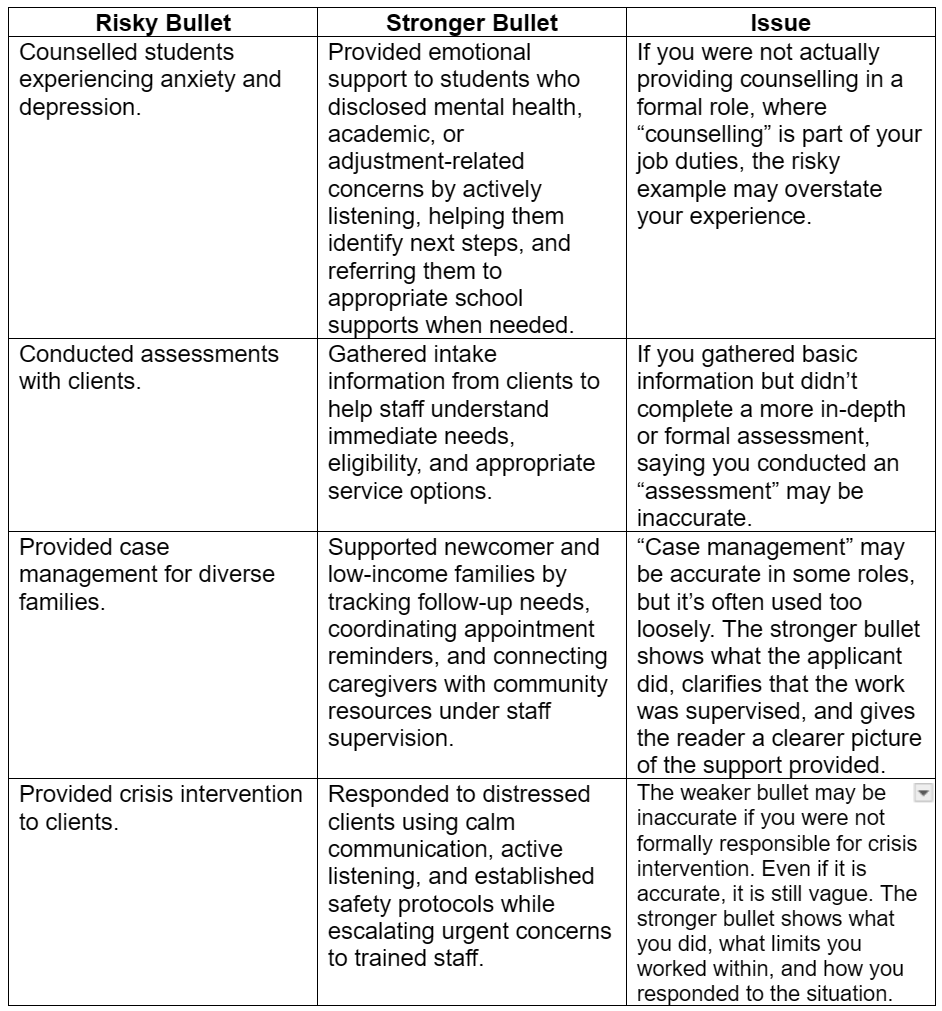
4 examples of weaker vs. stronger bullet points. Email info@mswhelper.com for text version.
Even when a social work term like “crisis intervention” is accurate, it usually shouldn’t be doing all the work. A bullet that says “provided crisis intervention to clients” may be true, but it’s still vague. Stronger bullets explain what that looked like in practice, such as assessing safety concerns, using de-escalation strategies, following protocols, consulting supervisors, documenting concerns, or connecting the person with additional support. The more specific version helps the reader understand both the scope of your role and the specific skills you used, making for a stronger resume.
Problem #2: Using Social Work Keywords in a Way That Sounds Vague
The second issue is using social work terms without showing what they mean. Terms like “trauma-informed,” “strengths-based,” “client-centred,” “culturally responsive,” and “anti-oppressive” can enhance your social work resume, but only if the bullet makes it clear what those words look like in practice. They should not be dropped into a bullet without providing additional context.
For example:
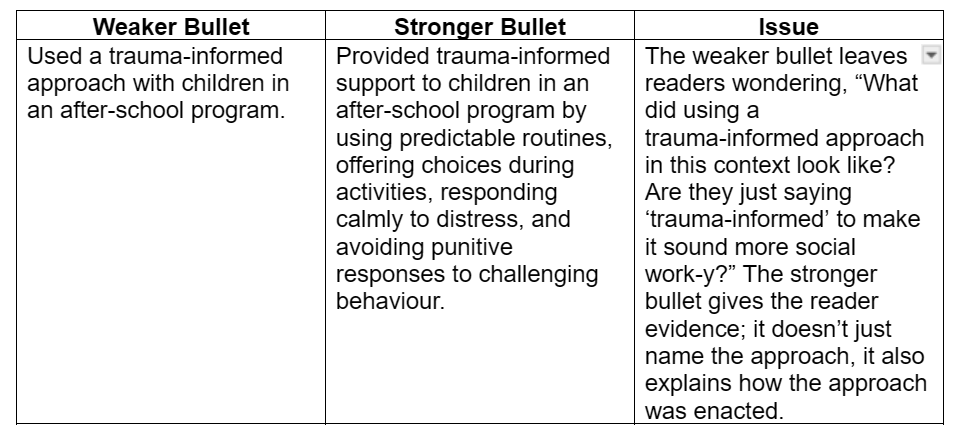
Weaker bullet: Used a trauma-informed approach with children in an after-school program. Stronger bullet: Provided trauma-informed support to children in an after-school program by using predictable routines, offering choices during activities, responding calmly to distress, and avoiding punitive responses to challenging behaviour.
Issue: The weaker bullet leaves readers wondering, “What did using a trauma-informed approach in this context look like? Are they just saying ‘trauma-informed’ to make it sound more social work-y?” The stronger bullet gives the reader evidence; it doesn’t just name the approach, it also explains how the approach was enacted.
A good test is to ask yourself: If I removed the keyword, would the reader still understand what I actually did and how it’s relevant to social work? If the answer is no, the bullet probably needs more detail.
Problem #3: Assuming the Reader Knows Your Acronyms
Another common mistake is assuming the reader will know what every acronym means. I often find myself reminding applicants that admissions reviewers and hiring managers may not be familiar with every agency, program, certification, intervention, or service system you mention. Even if they work in social work, they may not know the shorthand used in your specific workplace, province, state, school, hospital, nonprofit, work, or volunteer setting.
As a general rule, spell out acronyms the first time you use them, then put the acronym in parentheses.
For example:
Applied Suicide Intervention Skills Training (ASIST)
Children’s Aid Society (CAS)
Individualized Education Plan (IEP)
Activities of Daily Living (ADLs)
Electronic Medical Record (EMR)
This is especially important since acronyms sometimes mean different things in different contexts. For example, “ACT” could refer to Acceptance and Commitment Therapy or Assertive Community Treatment.
How Many Bullets Should Each Role Have?
There is no perfect number of bullet points for each role.
For employment resumes, you usually need to be more selective because employers often expect a concise 1–2 page resume, unless you have extensive relevant experience.
For MSW applicants, there is often more flexibility since many programs don’t give a strict page limit, meaning you may have room to include more detail. That said, you shouldn’t include every task you’ve ever done.
A longer resume can be completely appropriate if the information is relevant, well-organized, and not repetitive. The problem is typically not the number of bullets by itself, but when several bullets are doing the same job.
For example, notice how these bullets overlap:
Provided support to clients accessing community resources.
Connected clients with local services and supports.
Helped clients identify appropriate referrals.
These could likely be combined into one stronger bullet:
Connected clients with community resources by identifying needs, explaining referral options, and coordinating follow-up with staff.
When deciding how many bullets to include, ask yourself:
Is this bullet showing something new about my experience?
Does it add a different skill, responsibility, population, setting, or accomplishment?
Is it relevant to social work education, field placement, or the job I want?
Could this bullet be combined with another one?
Is this detail important enough to take up space on the resume?
For highly relevant roles, such as human service jobs, social work placements, crisis lines, shelters, research roles, advocacy work, leadership roles, or significant volunteer work, you may need several bullets to show the full scope of your experience.
For less relevant roles, you may only need a few bullets that highlight transferable skills.
A helpful approach is to start with one overview bullet point that summarizes the role, setting, population, or purpose. Then use the remaining bullets to showcase the most relevant responsibilities, skills, or accomplishments.
Final Resume Bullet Checklist
Before finalizing each role description, ask yourself:
If the role title is not self-explanatory, does the first bullet give the reader a quick “what I did in this role” overview?
Does this bullet show a skill, responsibility, accomplishment, or experience relevant to social work or graduate study?
Does it explain who I worked with and/or what setting I worked in?
Does it show what I actually did, not just what the organization does?
Have I included numbers, frequency, or scope where helpful?
Am I using accurate language without overstating my role?
Have I spelled out acronyms or specialized terms that may not be obvious?
Would an admissions reviewer or hiring manager understand why this experience matters?
Is this bullet specific enough to be believable?
Does this bullet add something new, or does it repeat another bullet?
Are the most relevant bullets listed first?
Does this role description, as a whole, show why this role is relevant to social work education, field placement, or practice?
Want feedback on your social work resume? Through our Resume Editing and Critiquing service, we can help you highlight relevant experiences and transferable skills. We’ll connect your work, volunteer, and academic experiences to social work practice and help you organize your resume using best practices. The service also includes three resume templates tailored to social work students and professionals.